 0
0
 0
0
The Role of the Regula Fidei the “Rule of Faith”
The Role of the Regula Fidei in the Twenty-First-Century Religious Landscape: How the “Rule of Faith” Can Help Address the Existential Issues of the Postmodern Christian Community
By Roland Weisbrot
Summary of the Article
This article by Roland Weisbrot, published in Themelios (Volume 50, No. 2, August 2025) by The Gospel Coalition, explores the historical and contemporary significance of the regula fidei (Rule of Faith) in defining Christian identity and orthodoxy amid postmodern challenges.
Weisbrot argues that the Rule of Faith—a summary of core apostolic teachings about Christ—serves as a hermeneutical key to preserve the Christian metanarrative, guide scriptural interpretation, and address existential crises in a pluralistic, subjectivist era. It counters threats like the linguistic turn in philosophy, which reduces truth to power and narrative control, by providing boundaries for orthodoxy without stifling interpretive variety.
Key Structure and Arguments
- Background and Problem Statement:
- The postmodern context has eroded the Christian grand narrative through Enlightenment rationalism, the linguistic turn (e.g., Wittgenstein’s language games), and influences like Nietzsche and Foucault, leading to subjectivism and hermeneutical crises.
- Traditional solutions like magisteriums (the Catholic Church’s official teaching authority), ecumenical councils, or academic faculties fall short due to human fallibility and potential for error.
- The Rule of Faith emerges as a solution: it’s derived from apostolic kerygma (preaching), aligns with Scripture (e.g., Jude 3), and defines Christian identity by focusing on Christ’s revelation.
- History and Authority of the Rule of Faith:
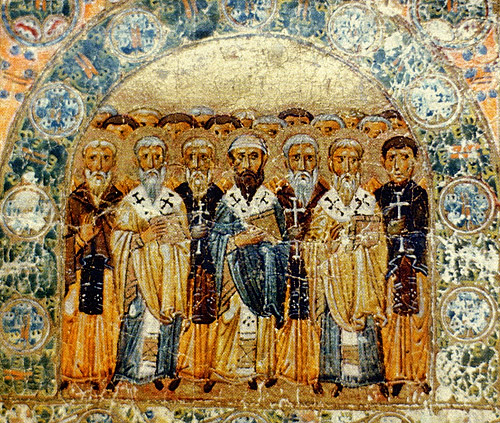
- Originating in the second century amid Gnostic threats, the Rule was articulated by early Church Fathers like Irenaeus, Tertullian, Origen, and Augustine.
- Irenaeus used it in Against Heresies to counter secret gnostic knowledge, emphasizing its public, apostolic, and universal nature as a “canon of truth” intertwined with Scripture.
- It’s not independent of Scripture but a condensed summary of its core doctrines (e.g., God as Creator, Christ’s incarnation and redemption, the Holy Spirit’s role).
- Authority stems from its apostolic roots and role in safeguarding orthodoxy, with Scripture as the ultimate norm interpreted through the Church’s tradition.
- Modern Interpretations:
- Narrative Approach (Paul M. Blowers): The Rule functions as a metanarrative framing creation, incarnation, redemption, and consummation. It provides a “dramatic structure” for interpreting Scripture and Christian experience, rejecting subjectivism and ethnophyletism while allowing flexible local expressions.
- Linguistic Approach (Robert W. Jenson): Paired with the canon, the Rule offers a “communal linguistic awareness” of the faith, establishing boundary markers for the Church. It counters liberal “hellenization” critiques and preserves key terms and events for continuity.
- Role in Hermeneutics:
- Patristic Era: The Rule guided exegesis in the Church, ensuring Christocentric unity (e.g., Irenaeus’s “hypothesis” harmonizing Scriptures; Augustine’s use for boundary-setting while allowing variety, guided by love).
- Modern Era: Amid historical-critical methods, the Rule shifts focus from elite academia to the believing community, promoting “divine meaning” over strict authorial intent. It enables Scripture to interpret itself within orthodox bounds, aligning with sola scriptura.
- Contemporary Application:
- The Rule preserves doctrinal language, identifies true believers (aligned with its Christocentric content and marked by the Holy Spirit’s fruit), and rejects heterodox interpretations.
- It doesn’t resolve every postmodern query but creates an “arena of orthodoxy” for dialogue, emphasizing truth as a person (Christ) rather than an abstraction.
- Believers are called to abide in Christ, producing fruit, while recognizing ongoing sin and the eschatological nature of perfect understanding.
Conclusion and Implications
Weisbrot concludes that the Rule, as a linguistic-narrative inheritance, safeguards the apostolic faith alongside Scripture. In a revisionist age, it helps discern genuine Christianity by rooting it in the community of believers where Christ is present. The article calls for reclaiming this tool to navigate identity crises, preserving orthodoxy without remaking Christianity in a postmodern mold.
This piece is particularly relevant for Protestant audiences grappling with hermeneutical authority, offering a balanced retrieval of patristic wisdom for today’s challenges.