 0
0
 0
0
Jesus Christ & the Pattern of Christian Manhood
Adapted from the article by Leon J. Podles
Jesus Christ is the Son of God incarnate. He is the Logos, the Word of God made flesh, having taken upon himself a complete human nature. He is fully and completely human. There is nothing lacking in him that makes up a full human being. He has a body, a mind, a soul, a will. He is God’s complete utterance. The Father has nothing more to say than what he has said in his Word.
These dogmas were hammered out in the debates of the first centuries of the Church, and express in words the limits within which Christians can think about Christ. We cannot believe there was a time when he was not, as the Arians claimed, or that he had no human will, as the Monothelites claimed.
Having said that we must note that these theological formulations, while necessary to safeguard the faith of the Church, do not express all the aspects of Christ that can capture and transform the imagination.
We do not live by syllogisms, however much truth they express, but by vivid revelations and types and shadows and parables and examples.
Jesus in Scripture is the Suffering Servant, the Lamb of God, the Faithful and True, the Son of Man. These images stir the mind and heart, and assist in the conversion of the whole man, who is not simply intellect.
Another critical image that sums up and expresses what Jesus is in the world is Jesus as Hero.
The Hero
We speak loosely of any courageous person as a hero. Courage is essential to heroism, but it does not make the hero. A hero involves a story, a mythos, a plot. But because myth has a misleading overtone of untruth, I will speak instead of the story or the narrative of the hero.
A hero leaves the everyday world, faces challenges, sufferings, and even death, is transformed through them, and then returns to the ordinary world, usually as a king. The pattern is simple, and can be found in the epic of Gilgamesh and in Walt Disney’s cartoon Hercules and in thousands of stories in between.
The story of the hero has been explored by folklorists, literary scholars, and Jungian analysts.
The clue to the presence of the story of the hero in almost all cultures lies not in folkloric borrowings or “solar myths” or Jungian archetypes, but in human nature, specifically in the nature of the human male, and in the story of the life of every male who sets out to become a man.
What Every Man Should Be
The hero is universal because he represents what every man should be. His experiences are those that a boy goes through in the process of becoming a man. Stories of heroes are found throughout the world simply because boys become men throughout the world. The story of the hero is almost universal because it is in essence the story of males trying to be masculine.
What is Masculinity?
It is generally connected with assertiveness or aggression, and those are certainly elements, but obviously there is much more.
Aristotle described the male as active, the female as passive.
Masculinity cannot be understood as a state; it is a trajectory or a story.
It is a story that is not arbitrary. Masculinity and femininity are not, as is frequently claimed, purely social constructs.
They are based in our very different DNA that comes from the original creation design of male and female in Genesis, and the command to be fruitful and multiply.
Yes, it’s about sex, but also much more than that, it is about healthy family!
1 Separation
The first point of human nature that shapes masculinity, that we will investigate here, is that the boy is born of a woman. At first, all infants have an oceanic consciousness. In other words, the infant cannot distinguish between himself and his mother. But gradually the infant begins to realize his mother is another person and not simply an appendage of the self. Both boys and girls come to this realization, but the boy comes to realize that the person in the world to whom he is closest, whom he loves more than anything, is something he cannot and should not become: a woman and a mother.
This begins the uniquely male process of separation by which the boy is transformed into a man.
2 Male Disposability
The second point of human nature that shapes masculinity, that we will investigate here, is that the male is more disposable than the female in society. As an example, a man can beget a child and die shortly after. If the women dies while pregnant, then obviously everything ito the children stops.
Societies make use of this comparative disposability of the male by assigning to males the more dangerous tasks in society.
A man must always be ready to give up his life: “The accepting of this very expendability . . . often constitutes the measure of manhood, a circumstance that may help explain the constant emphasis on risk-taking as evidence of manliness.”
Women endure the danger of childbirth which men obviously do not have to face, but men bear many other dangers.
It may be working in mines; it may be fighting lions in Africa; it may be working as a garbage man or lumberjack, utility lineman, or soldiering —hazardous occupations, and almost entirely male. It may even be working 80 hours a week as an executive in Silicon Valley, a pace of life that leads males to die several years younger than females.
This exploitation of the male is not disappearing. The gap between the life expectancies of men and women in America is larger now than it was at the beginning of the twentieth century.
Modern life has been hard on men.
3 Male Aggression & Assertiveness
The third point of human nature that shapes masculinity, that we will investigate here is that males are more aggressive than females. The degree of aggression varies, but it is obvious to anyone who has observed animals or boys going through puberty that testosterone feeds aggression.
“Roid rage” is recognized among athletes who take testosterone to build up muscle.
In Summary of these 3 Points
These three observations make the male both dispensable and assertive. Assertiveness can be used for purely selfish reasons and self-preservation, but it can also be put to the service of society by leading men to take on the dangerous jobs that every society has. The danger may come from “enemies” such as weather, animals, criminals, or economic forces. It may also come from heresies and deceptions, lies and half-truths that break down society.
Societies must train their males to be both assertive and self-sacrificing, a difficult combination.
If masculinity traditionally often led to early death, how can males be convinced that they should become masculine and therefore become truly men?
The avoidance of pain and seeking of self-preservation are universal to all creatures, even irrational creatures. Almost all societies, as Yale anthropologist David Gilmore shows in Manhood in the Making, have developed an ideology of masculinity, a pattern of self-sacrificial behavior.
But how do societies persuade males to buy into this ideology? How are males convinced that they should act against the instinct of self-preservation and sacrifice themselves for the good of their societies?
Ritual & Story
The cultural values required are taught and demonstrated and explained by traditions, ceremonies, by preaching and by parables and by demonstration.
The ideology of masculinity is inculcated in boys through ritual and story.
Initiation rites or rites of passage, which usually occur at puberty, are found throughout the world. The boy is taken from his mother and the world of women and subjected to trials.
In primitive societies that have a simple challenge, such as hunting or fighting to protect the village, this trial is often encapsulated in a puberty ritual. Other trials may include ritual scarification, or circumcision, or scourging. In some tribes’ boys may die during these ceremonies.
Facing Danger without Flinching
Boys have to learn to face danger and death without flinching. There is often some sort of ritual death. Having been reborn as a man, the boy can now face the dangers that threaten his community. Eventually he can reconnect to the world of women by marrying and fathering children, but now as a protector and provider, no longer as one protected and provided for.
More complex societies do not have single rituals because the challenges they face are multiform. Boys and men go through a variety of trials and may never be totally assured they are men. Ancient German and Greek societies do not seem to have had true puberty rituals; rather, they had experiences—athletic contests, battles, travels—that had to be lived through repeatedly to prove one was a man.
Thus, masculinity is a pattern of initial union, then separation, and finally reunion, while the feminine, by contrast, is a maintenance of or striving for unity, an important characteristic, as we shall see in my consideration of the feminine in the Church.
Heroism Fulfilled in Christ
All stories are completed and perfected in the story that is revealed to us in Scripture. Even so the meaning of heroism is also revealed. Like all created realities in the world, it has a double meaning.
Jesus Christ fulfils, corrects, and transcends human heroism.
Jesus fulfils the role of hero:
- He has a mysterious birth;
- he leaves the safe world of the feminine at age 12, when he tells his mother that he must be about his Father’s business;
- and again at the beginning of his public ministry, he leaves her and the world of everyday life behind.
Rejected by his own people, Jesus tastes the ultimate suffering of crucifixion, of death, of abandonment by his own Father. He descends into hell, into the utter darkness of rejection by God. He became sin. He confronted the primeval and devouring monster that lurks in the darkness outside, the monster that haunts the stories and nightmares of man, whether he is called Coyote or Behemoth.
That monster is death.
Jesus, like the heroes of myth, confronts death and enters death and triumphs over death. But what the heroes do only in fiction, Jesus does in reality.
By his death he conquers death, and returns to the Father, bearing all creation, which he has rescued from death, with him.
Ancient Christian Icons of Resurrection
It is this dazzling monument that is the center of all history and depicted in the great painting of the Anastasis—the Resurrection. In the best Iconic Painting of the Resurrection, Jesus with one hand pulls Adam out of the grave and with the other hand Eve. His divine power and strength flow through the crucified and glorious hands that now give life to the universe.
Heroes are praised because they rescue, for a while, their people from danger and death.
But Jesus has rescued the universe.
He has been utterly transformed by his encounter with death, and through him that transformation flows into all creation. He is the God-Hero. Like conquering emperors, he marches in triumph, but in his train are the angelic powers that he has taken captive (Eph. 4:8). In the Apocalypse, the deepest meaning of the cosmic struggle is shown, the battle between the dragon and the Rider on the white horse, the Word of God (Rev. 19:19–20).
The Dark Side
But human heroism can become fleshly idolatry too, and this is why masculinity and heroism have been rejected by some Christians as essentially un-Christian. The figure of the hero is closely allied to that of the warrior, and both have the dangerous element that is implicit in masculinity.
The ordinary man, even outside of battle, is often dangerous to his society, because the power, the physicality, the confrontation required for war, whether spiritual or other may destroy the society.
Aggression may rage unchecked, and just like anger, which is not wrong when righteous and controlled and directed correctly, aggression and confrontation can get toxic.
Know your Enemy
The war a Christian man is called to is spiritual and his own flesh the greatest and primary enemy, but the need for deliberate confrontation and sustained determination is not removed.
Even though the initial enemy is self and flesh, that does not mean that heresy, half-truths and lying spirits do not require war.
The Spiritual War
Now I, Paul, myself am pleading with you by the meekness and gentleness of Christ—who in presence am lowly among you, but being absent am bold toward you. 2 But I beg you that when I am present I may not be bold with that confidence by which I intend to be bold against some, who think of us as if we walked according to the flesh. 3 For though we walk in the flesh, we do not war according to the flesh. 4 For the weapons of our warfare are not carnal but mighty in God for pulling down strongholds, 5 casting down arguments and every high thing that exalts itself against the knowledge of God, bringing every thought into captivity to the obedience of Christ, 6 and being ready to punish all disobedience when your obedience is fulfilled. ” (2 Corinthians 10:1–6, NKJV)
Jesus as Obedient Hero
Jesus fulfills the pattern of the hero in an unexpected manner. He did not lead the Jews in successful war against the Romans to reestablish the kingdom of his father David. Instead, the war he leads is against the real forces of evil that are hidden behind the façades of history. The real enemy of God is not the emperor, but the spirit who is prince of this world, the spirit who in the beginning disobeyed God.
Jesus conquered this spirit of rebellion by his own obedience.
In his human will he did something he could not do as God: He obeyed.
As un-incarnate Son, he had the same will as the Father, so it is impossible to speak of his obedience, of the submission of his will to his Father’s. But incarnate, he had a will that was not the same as his Father’s and that therefore had to be submitted to the hard realities of suffering and death, from which his human nature recoiled.
By this obedience, Christ rendered the many righteous. He revealed true heroism, the conquest of one’s own nature, and its submission to death to save his brethren. All heroes sought to save others by entering and challenging death. But only one truly did it, entering death, not from bravado or self-affirmation, but from obedience.
Such obedience differentiates the heroism of Jesus from that of other heroes. They sought to affirm the self by not flinching in the face of death, and thereby establish their names forever, lest they be lost in oblivion. Jesus also did this, but his self-abandonment was even greater; he submitted everything to the will of his Father, who raised him from the dead.
The Name above All Names
Jesus did not seek glory from men, as all other heroes did, but from his Father alone. Jesus is completely and totally the Divine Son; there is nothing in him that he does not receive from the Father. Jesus’ obedience gives him the Name that is above all other names. The names of heroes—Gilgamesh, Hector, Achilles, Odysseus, Beowulf, Siegfried—fade into the mists of legend, but the name of Jesus grows louder through the millennia.
The heroism of the Christian is therefore both like and unlike that of the merely human hero; the masculinity of the Christian is therefore both like and unlike the masculinity that all men are called to. It is real masculinity, and it is real heroism, and the early Church clearly understood this.
Monks and Ascetics
When the persecutions ended after Constantine, the Monk became the true soldier and athlete, the true hero of the new people of God. The battles of the Monk against the spiritual enemy established him as the new hero and soldier.
The masculinity of the desert fathers is overwhelming; they went into dangerous places and camped out for decades. Asceticism sometimes became an “extreme sport,” as exemplified by Monks living on the tops of columns or praying while submerged to the neck in the northern seas. It is even sometimes amusing. In a display of male competitiveness, ascetics sometimes tried to outdo each other in rigor and were gently rebuked by their spiritual fathers.
Germanic Evangelisation was Masculine
When Christianity was first preached to the Germanic tribes, Christ was preached as the true hero. The Saxon Heliand depicts Christ as a hero and his disciples as his thanes. Beowulf was written down in a monastic environment, and it may be that the three battles of Beowulf, against Grendel, Grendel’s mother, and the dragon, paralleled the three renunciations of the monk: self-will, kin, and wealth.
The best expression of this view of Jesus is in the Anglo-Saxon “Dream of the Rood,” in which the Rood, or Cross, speaks. It tells how it saw Christ the young Hero stripped for battle, mounting the Cross to face the enemy.
The Brotherly Bond forged in Battle
The stories of heroes are also the stories of great friendships. The love that men of war bear for each other has a special mark.
Men cannot unite in sexual union.
Their legitimate union, spiritual and physical, has a character marked by suffering and death. Achilles and Patroclus, Jonathan and David, Gilgamesh and Enkidu—all the loves of heroes are marked by death. Only in death can men achieve the closeness of union that a man and woman can achieve in a fruitful sexual union. In the mingling of blood, men become brothers.
This type of love is found in the love of Jesus and his disciples. Jesus loves his disciples, and therefore dies for them. He gives them a memorial of himself in the Eucharist, established the night before he suffered. He achieved the closest union by uniting his disciples with his sacrifice.
Men Unite in Death
After his resurrection, this connection continues. He asks Peter three times if Peter loves him, and the change in the word for love in the three questions and Peter’s three replies may indicate the special quality of brotherly friendship that Jesus seeks. The love of Jesus leads to a union with him in death, as he tells Peter.
He who does not take his cross and follow after Me is not worthy of Me
This shadow of death is forgotten in most of Christian preaching. The seriousness of following Jesus is forgotten. We can be united with him only by dying and rising with him. That death may well involve martyrdom, even or especially today—more Christians have been martyred in the twentieth century than in all other centuries combined.
Even when the Church lives in peace, this union with Jesus in death is still inescapable. The early ascetics fled into the desert after the end of the persecution because they feared that Christians were forgetting the spiritual warfare in which they were to be involved. A Church that is heroic will have its martyrs in times of persecution and its ascetics and monastics in times of peace.
Asceticism and monasticism are forms of martyrdom. Asceticism originally meant athletic training. The seriousness and importance of the Christian life is established by the sacrifices that are made to live it.
The Christian consecrated unto death is therefore at the heart of the Church, and without his presence the Church falls into worldliness. The traditional missionary in a war zone.
Cost of Discipleship
Matt. 16:24–27; Luke 9:22–26
34 When He had called the people to Himself, with His disciples also, He said to them, “Whoever desires to come after Me, let him deny himself, and take up his cross, and follow Me. 35 For whoever desires to save his life will lose it, but whoever loses his life for My sake and the gospel’s will save it. 36 For what will it profit a man if he gains the whole world, and loses his own soul? 37 Or what will a man give in exchange for his soul? 38 For whoever is ashamed of Me and My words in this adulterous and sinful generation, of him the Son of Man also will be ashamed when He comes in the glory of His Father with the holy angels.”
” (Mark 8:34–38, NKJV)
Those of us who are not missionaries in war zones, who are married and are living in the world, must not forget that we live in a Church of heroes. Others have given up so much; the small and large sacrifices of everyday life are somewhat easier to bear when we remember what others have gone through. Our attachment to the faith is strengthened when we remember what price has been paid to bring it to us. The courage we need to live and proclaim the faith in a society that does not understand us and is suspicious of us can grow when we contemplate the heroes of the faith.
Godly Christian Heroism is lacking
But courage, heroism, and manliness are not words that are immediately associated with Christianity or even Christ. The image of Christ and of the Christian is one of weakness and effeminacy. A recent survey in England showed that the image of the Church of England most people have is of a middle-class men who like to wear dresses.
Indeed, why is the image of Christ that of a weakling, and why are men alienated from the Church? That men should turn from the Church because it is too difficult and challenging is not a danger, but that they should turn from it because they regard it as a refuge for weaklings is catastrophic.
The Church Impotent
I examined in my book The Church Impotent the possible roots of men’s fear that Christianity will emasculate them. I will briefly summarize the arguments that I make in my book.
The lack of men in church life in the West is documented by statistics and anecdotes that go back centuries, perhaps to the High Middle Ages. I need not belabour this point; I think it is evident. The only surprise I had in my research was discovering how far back this lack of men goes and how widespread it was and is. The causes seem to lie in a change in popular piety and theology, specifically in philosophical anthropology. The change in popular piety was the rise of bridal mysticism; the change in philosophy was the acceptance of Aristotle’s characterization of the masculine and feminine.
Bridal Mysticism
First, I will consider bridal mysticism. Israel and the Church are seen in scripture as the Bride of the Lord in Scripture. St Origen, perhaps influenced by the sacred marriages of the mystery religions of the day, applied this image to the individual Christian, claiming that the individual Christian, too, was the bride of God.
Various Fathers took up this suggestion, but it did not enter into popular consciousness until Bernard of Clairvaux preached his sermons on the Song of Songs, which was the most commented upon book of the Bible in the Middle Ages. For Bernard, the patristic image took on new erotic intensity, and for women mystics, influenced by the cult of Minne and courtly love, Jesus became the handsomest and most desirable of spouses.
Scripture teaches that the church corporate is the bride of Christ not the individual, male or female. Many girls envisage themselves as Jesus bride, in her personal capacity but that is heresy.
Erotic Baroque Art
Baroque art continued the characterization of charity as eros. Baroque churches are filled with statues of cherubs darting arrows at the hearts of the congregation.
Bernini’s St. Teresa in Ecstasy shows Teresa in an erotic rapture, and a young smiling angel thrusting an arrow into her heart. St. John of the Cross wrote magnificent poems in which he used the image of the soul as a bride. Popular Roman Catholic devotions for centuries were full of quasi-erotic language. Even today, bridal spirituality, often under the cloak of Marian spirituality, is widespread among Catholics.
Protestantism inherited this spirituality from Catholicism. I have been told by Protestants that when people hear the phrase “personal relationship with Jesus,” they interpret personal as romantic, if not erotic.
Men do not like to have romantic or erotic relationships with other men, even if that man is Jesus. Such notions are also heresy, and even more so. Also it is extremely damaging the spiritual growth of young men.
Receptive Men?
Back to the history. Secondly, there was a change in philosophy when scholastic theologians reinforced this bridal distortion in Christian spirituality. Aristotle had taught that the masculine was active and therefore superior, the feminine passive/receptive and therefore inferior.
Christian Aristotelians pointed out that in Christianity it was better to be passive and receptive than active, because Christians had to receive the imprint of Christ by the Holy Spirit. Therefore, women, relatively lacking in aggression and power, were better raw material for the Spirit than men were.
Women were therefore better Christians, and Mary was the supreme model of Christians, as she was perfectly receptive. This explanation has continued to be the received model for understanding masculinity and femininity among Christians, including even C. S. Lewis and Pope John Paul II.
Both bridal mysticism and the scholastic definitions of masculinity and femininity create problems for the image of Christ. In bridal mysticism, Christ is seen as a Bridegroom.
In the biblical use of this image, bridegroom implies the authority of Christ over the Church, an authority based on his masculine sacrifice of himself for the Church. Matters such as acting first, penetration and impregnation, and ruling are the point, not erotic romance.
Jesus as Boyfriend
In bridal mysticism, Jesus also must be seen as erotically desirable. When men say: I’m in love with Jesus, my neck hair stands up. There is no such phrase in scripture. Christ does not relate like that to the Father either! Certainly not. Read John 10:17 for one.
17 “Therefore My Father loves Me, because I lay down My life that I may take it again. 18 No one takes it from Me, but I lay it down of Myself. I have power to lay it down, and I have power to take it again. This command I have received from My Father.” ” (John 10:17–18, NKJV)
Extremely masculine and even military language.
Effeminate Men
I have difficulty understanding this, but I recently have noticed that increasing numbers of women seem to prefer the adolescent male type who is still a bit feminine, the ephebe of Greek art.
Powerful masculinity — muscles and beard and sweat—seems to be, for many women, less desirable than a softer man, who more often than is also just plain weak.
The image of the erotic Christ, the holy-card Christ, was a softened and feminized Jesus has taken its toll.
Women do not need men to survive anymore as it was in previous eras, and so a boyfriend as a type of love-kitten has become popular. Whether some women actually prefer this feeble man, or whether powerful men are simply not available anymore are both factors playing a role.
Marian Spirituality
The philosophical characterization of the feminine as receptive seems to explain the role of Mary in Catholic spirituality, but it creates major problems for the image of Christ.
What of Christ’s masculinity?
Shouldn’t he have been feminine? He often is shown as such in popular Western art, social media and modern movies. Christ’s confrontational and prophetic masculine characteristics are anathema to liberals.
This sadly is also serves as an easy excuse for the lack of men in the Western Church.
Byzantine Art is Better
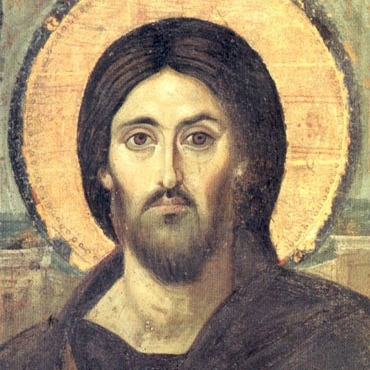
Byzantine art has presented a far more accurate and masculine figure of Christ, for instance, the famous Christ of Mt. Sinai, who has the face of a prize-fighter, beaten and bruised.
My wife, an art historian, believes it was based on the Shroud of Turin, the “image not made with human hands.” Later iconographers realized that the face on the Shroud had been beaten, and corrected their portrayal, but ever Christ is shown as a strong man.
Christus Pontecrator
In the Pontecrator icon, Christ dominates the church, and in the Paleologan miniatures, the Christ of Palm Sunday has a young, strong face, and a lock of hair in front that cannot be combed back.
Perhaps the best icon of Christ is the Anastasis in Constantinople. In it Jesus is shown in contrapasso, with his body twisted.
In Western art, this is often merely decorative and mannered. Here, however, he is pulling Adam from the grave with one hand and Eve from the grave with his other hand. The divine strength in his arms can raise the dead.
The Damage is not only in Art but also Behaviour
The visual image is not the only aspect of Christ that has been distorted. If they were honest, many modern Christians would say that Jesus was not behaving in a very “Christian way” when he excoriated the Pharisees or threw the moneychangers out of the temple. Even so the answer Jesus gives in Luke 13 and certainly the curse of Matthew 23 to name but two.
The strength of God, the judgment of God, the mysteries of friendship and brotherhood achieved only through a mingling of blood in death are not in the minds of ordinary Western Christians even when they read the Gospels.
The intense love express in military language of John 10:17 and the Triumphal entry of Christ into the throne room of Hebrews 1 are not understood celebrated of believed anymore.
Effeminate Western Liturgy
The Western Liturgy of the Roamn Catholic Church has also been heavily feminized. Even before the liturgical disasters that followed the Second Vatican Council, the Mass was not ordinarily experienced as a dreadful and awe-inspiring mystery, although there was more of that before the council than there is now.
The devotions that were then popular in the Roman Catholic Church were aimed mostly at women, and the more recent reform of the Western Liturgy has turned it into a ceremony in which the “community worships itself”.
Forgotten are the divine and life-giving mysteries, the true initiation into the mysteries of life and death that all human beings, and men especially, yearn for.
The fear of God at the Smoking Mountain..
Even the language of the Liturgy in the West has been toned down. Most distinctly masculine references have been sought out and removed whenever possible.
Even more subtly, spiritual warfare and the contrast of heaven and hell are toned down in modern translations, so that Christians seek not a confrontation, but a rapprochement with the world.
The Eastern Orthodox and Eastern Catholic churches, whether they use the Liturgy of St. John Chrysostom or the Mass of St. Gregory, at least have the advantage of a Liturgy that is still a celebration of the Mysteries, not a communal get-together.
Eastern Spirituality escaped Bridal Mysticism
Eastern spirituality seems to be free of bridal mysticism and its attendant eroticism, which so repels normal men.
I would caution Orthodox Christians in the West to be very discerning in their reception of customs and spirituality that developed in the West after 1054. This is true even of the great spiritual classics.
The Spiritual Exercises of Ignatius Loyola are a revival of ancient patristic and monastic spirituality, in a form that is perhaps more accessible to the Western mind.
The bridal mysticism of Teresa of Avila, though undoubtedly expressing her experience of divine union, uses language and images that are not helpful and fruitful in the current situation of the Church.
The image of Christ that we should cultivate is simply that of the Scriptures—the human history of Jesus in the Gospels and the unveiling of his cosmic role in the Epistles and in the Apocalypse.
Initiation into Mysteries of Life and Death
Men yearn for initiation into the mysteries of life and death. Some seek it in Freemasonry, in nazism, in drugs, in extreme sports, but these are false paths.
There is only one Way, and it is the fault of the Western Church that this way has been obscured in the minds of men by a distorted image of Jesus.
Men yearn for purpose, mission, Kingdom, war and friendship, and the West offers them a romantic relationship with a half-feminized Jesus.
Where is Ruler of the Nations, with His Iron Rod and terrific judgment, where is Christos Pantocrator, the Lord of Hosts who commands the Armies of the lord of Hosts.
Christ on a White Horse
11 Now I saw heaven opened, and behold, a white horse. And He who sat on him was called Faithful and True, and in righteousness He judges and makes war. 12 His eyes were like a flame of fire, and on His head were many crowns. He had a name written that no one knew except Himself. 13 He was clothed with a robe dipped in blood, and His name is called The Word of God. 14 And the armies in heaven, clothed in fine linen, white and clean, followed Him on white horses. 15 Now out of His mouth goes a sharp sword, that with it He should strike the nations. And He Himself will rule them with a rod of iron. He Himself treads the winepress of the fierceness and wrath of Almighty God. 16 And He has on His robe and on His thigh a name written:
KING OF KINGS AND LORD OF LORDS
” (Revelation 19:11–16, NKJV)
26 And he who overcomes, and keeps My works until the end, to him I will give power over the nations—
27‘He shall rule them with a rod of iron;
They shall be dashed to pieces like the potter’s vessels’—
as I also have received from My Father; 28 and I will give him the morning star.
29 “He who has an ear, let him hear what the Spirit says to the churches.” ’
” (Revelation 2:26–29, NKJV)
The clear and simple descriptions of Christ as conquering Hero and us with him.
Christ’s Masculinity is Mission Critical for all Men
Boys and young men must be shown that being Christian is essential to becoming masculine, to becoming fully a man.
Fathers must be biblical Elder as we in scripture and rule their families in spiritual matters. It is extremely important that a boy sees his father and other men in church who fear and obey Christ.
Boys will nearly kill themselves in sports to win.
They should be introduced to a Kingdom that is at war and is expanded but that requires discipled and well trained soldiers like Joshua and Paul.
Christian doctrine, discipline, spiritual reality and power, prayer, fasting, truth and judgment must be shown and taught.
Prayer is not simply words. It is a powerful penetrating lifegiving expression and proclamation of God Himself, through us.
One prays with the body, the mind, the strength, the soul and all your passion.
The World Needs a Father among many similar movements give action that men crave and provide an excellent framework for integrating clearly masculine activities with religious instruction.
There are many practical step one can take.
The unfruitful traditions that obscure and distort the masculinity of Jesus and of the Christian are deeply entrenched in the West. Feminists now control many of the churches and social media, and are making a bad situation even worse.
But in our gardens, each plot of land that Providence has allotted to us during our time on this earth, we can make small improvements and plant the seeds that may one day bear unexpected spiritual fruit.
Our obedience is the best instrument that God has to carry on the work of Christ in the world today. Like good soldiers, we ask only that our sacrifices hasten the day of final victory, a victory that Jesus our hero has already won.