 0
0
 0
0
“Chronological order of the books of the Bible.”
Please note that the numbers below in bold are the traditional English order:
Order of Writing for the Books of the Bible
Old Testament (n.b., this is a “higher chronology” than you will find elsewhere = dates are earlier than in many liberal sources; numbers in bold represent the traditional English order):
1. 1440 – 1400 B.C.
Genesis 1
Exodus 2
Leviticus 3
Numbers 4
Deuteronomy 5
2. 1400 – 1000
Joshua 6
Judges 7
3. 1000 – 586 B.C. (pre-exile – mid-exile)
Period of David and Solomon (ca. 1000 – 931):
Psalms #19
Ruth #8
1st Samuel #9
2nd Samuel #10
Job #18
Proverbs #20
Ecclesiastes #21
Song of Solomon #22
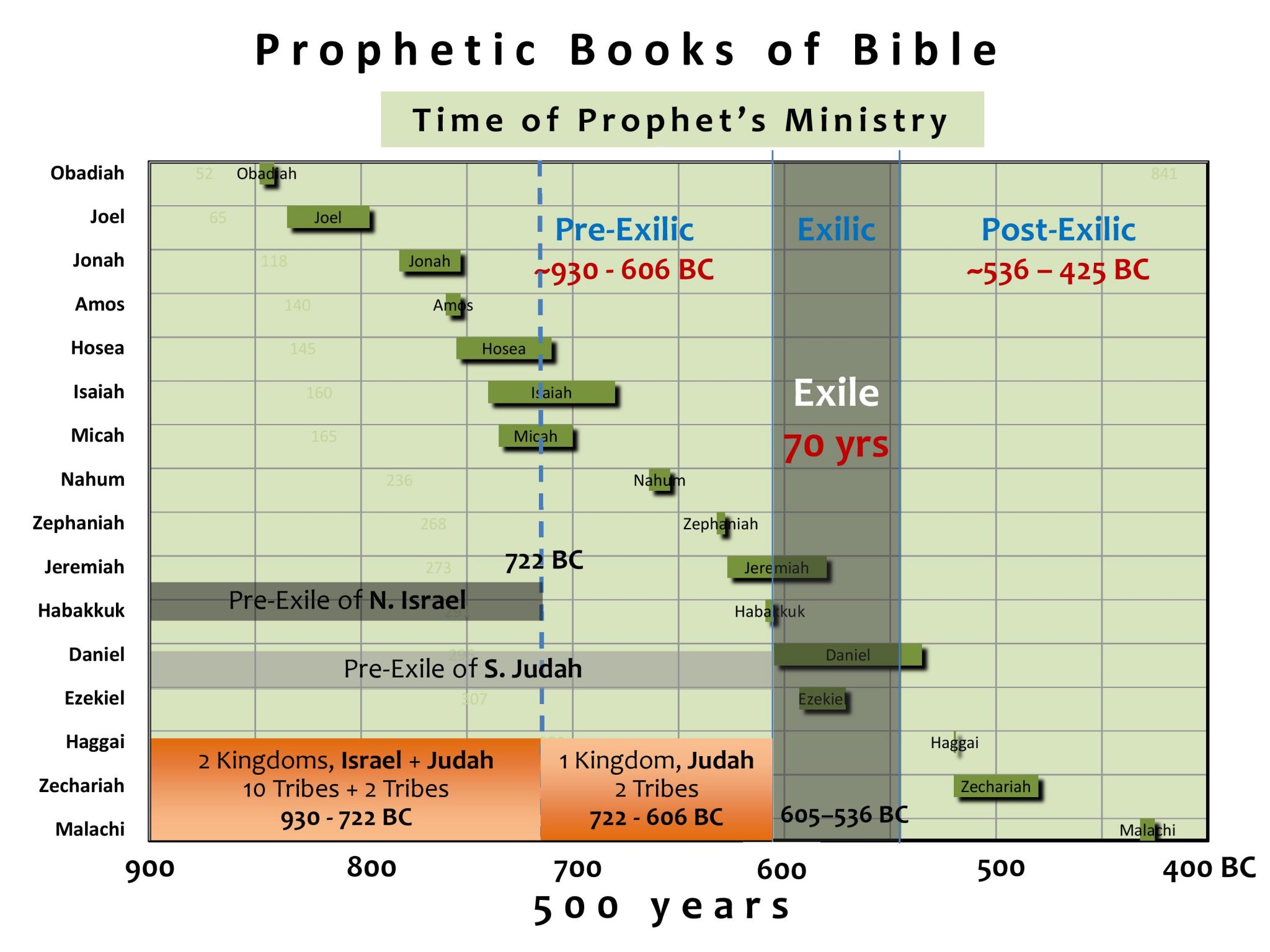
Period of Rehoboam to Hezekiah (931 – 686):
Isaiah #23
Hosea #28
Joel #29
Amos #30
Obadiah #31
Jonah #32
Micah #33
Period of Hezekiah to the exile (686 – 586):
Nahum #34
Habakkuk #35
Zephaniah #36
1st Kings #11
2nd Kings #12
1st Chronicles #13
2nd Chronicles #14
Jeremiah #24
Lamentations #25
Ezekiel #26
Daniel #27
4. 516 – 400 B.C. (post-exilic)
Ezra #15
Nehemiah #16
Esther #17
Haggai #37
Zechariah #38
Malachi #39
New Testament (n.b., this is a “higher chronology” than you will find elsewhere = dates are earlier; numbers in bold represent the traditional New Testament English order; parenthetical bold numbers are the traditional order in the Bible overall):
5. 40 – 45. A.D.
Matthew: #1 (#40 )
6. 45 – 50 A.D.
1st Thessalonians #13 (#52)
2nd Thessalonians #14 (#53)
1 Corinthians #7 (#46)
2 Corinthians #8 (#47)
Romans #6 (#45)
Luke #3 (#42)
7. 50 – 55 A.D.
Galatians #9 (#48)
Ephesians #10 (#49)
Philippians #11 (#50)
Colossians #12 (#51)
Philemon #18 (#57)
Acts #5 (#44)
1st Timothy #15 (#54)
2nd Timothy #16 (#55)
Titus #17 (#56)
Hebrews #19 (#58)
8. 55 – 60 A.D.
James #20 (#59)
Jude #26 (#65)
9. 60 – 65 A.D.
1st Peter #21 (#60)
2nd Peter #22 (#61)
Mark #2 (#41)
John #4 (#43)
1st John #23 (#62)
2nd John #24 (#63)
3rd John #25 (#64)
Revelation #27 (#66)
Commentary: While the canon of scripture is indeed inspired, the placement of the books is not. The order of the Hebrew Bible, for example, is somewhat different from the order you are no doubt familiar with (e.g., 1&2 Chronicles are the very last books, with Daniel placed along with Ezra and Nehemiah just before them). The earliest and best semi-complete manuscript of the New Testament, codex Sinaiticus, places Hebrews before Paul’s pastoral epistles, and Acts comes before James. This is certainly understandable inasmuch as the chronology of the life and ministry of the apostle Paul is very problematic, especially in regard to the dates of his epistles (see esp. F.J. Goodwin’s “A Harmony of the Life of St. Paul). Still, the first five books (“of Moses”) are universally first in the OT just like the gospels are in the NT, with the book of Revelation universally last. There is also the question, when you say chronological order, of whether you the date of the events described or the date of writing is meant – and there can be a wide divergence (as with Moses relating of the earliest events of mankind in Genesis). The book of Ruth, for example, is placed in our English Bible in its rough order of chronological events, but was possibly written during Solomon’s time.
Here are a few salient things that we do know more or less for certain: the Pentateuch was written first (by Moses, ca. 1400 B.C., I would say), and Revelation was written last (by John, ca. 68 A.D., I would say), so that our English Bible order of the very first and last parts of the Bible is indeed chronological. For many of the books of the Bible we are only able to give approximate dates. Psalms, for example, was written by a variety of authors and spans at least several generations beginning with David. Job seems to relate very early events – well before the Davidic kingdom (although it was most probably written down in Solomon’s day) – and so is placed with the “wisdom literature” after the books of Samuel and Kings. Acts, to take another example, was written after the book of Luke, and both were written in the mid to late first century A.D., but describe events earlier than many of the epistles written before them. No generally accepted chronology exists with any great specificity for most of the books of the Bible because the internal indications of dating are not sufficient to give us a precise fix in most cases, and so even those scholars with a high view of inspiration tend be divided over the exact dates of many of the individual books of the Bible, let alone the floruit of their divinely inspired human authors. To take but two examples, there is no consensus about who wrote the book of Job (I believe it was Solomon, giving the book a date of ca. the 10th cent. B.C.) or Hebrews (I believe it was Paul, giving the book a date of somewhere mid 1st cent. A.D.). As a result, there is a wide range of opinion even within the conservative, Bible-believing community about the authors (and therefore the precise dates) of these two books. That said, I do give below my own best estimate of the order of writing, and for more information you can of course always consult a good, conservative study Bible or Old / New Testament introduction (a good Bible dictionary like Unger’s also has a synopsis of most of these arguments listed under the individual books). Study Bibles and Introductions generally have information at the beginning of every book, including a section on authorship and date (although, as I say, the dating is most often given as a “range” within which the commentators believe the book may have been written).
The fact that this book of books spans fifteen hundred years and has yet been preserved intact for us by our Lord speaks volumes about its divinely inspired nature. And the fact that we know surprisingly little about some aspects of its provenance (like the precise dating of many of the books, as your question reveals) only goes to show that God’s superintendence of the process of the creation and preservation of His Word (and not the efforts of men, no matter how impressive and noble they have been) has always been the decisive fact in the gift of this book that reveals His Son to us.
Yours in Jesus Christ who is the very Word of God incarnate.
Bible Timeline © 2010 by Rich Valkanet, Discovery Bible and Biblos.com